News Analysis: Rajesh Sirothia
Chief Editor Dopahar Metro
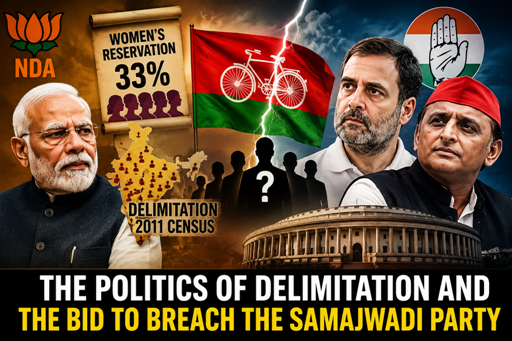
Women’s Reservation and delimitation have emerged as two of the most consequential issues in Indian politics. Far more than constitutional amendments, they have the potential to shape the country’s electoral landscape for the next decade. It is around these two issues that the most significant strategic battle between the ruling alliance and the Opposition is currently being fought.
One thing appears certain: the NDA government is determined to implement 33 percent reservation for women and expand the strength of the Lok Sabha from the present 543 seats to nearly 850. The real point of contention, however, is that the government reportedly intends to carry out this exercise on the basis of the 2011 Census. The Congress is not prepared to accept this proposal, largely because it fears that the new electoral arrangement could further weaken its already fragile political position.
Although the Congress still retains a committed support base that many describe as its “fixed deposit” vote bank, the party appears to be searching for ways to expand it. Critics argue that, instead of relying solely on its traditional ideological framework, it is increasingly seeking to consolidate support through caste-based politics. They contend that leaders from Jawaharlal Nehru to Indira Gandhi, Rajiv Gandhi and P.V. Narasimha Rao refrained from aggressively pursuing caste-based political restructuring because they believed that the British colonial emphasis on caste enumeration had deepened social divisions and widened the Hindu-Muslim divide.
According to this view, Rahul Gandhi and his close political advisers have revived the demand for caste-based mobilisation in an effort to overcome the Congress’s continuing electoral setbacks. Their critics believe the party has little confidence in defeating the BJP through governance, development, or organisational strength, and is instead attempting to build a broader anti-BJP social coalition. Supporters of the Congress, however, argue that caste enumeration is a legitimate instrument of social justice and equitable representation rather than a divisive political exercise.
Another criticism frequently levelled by the BJP and its ideological supporters is that the Congress has increasingly adopted ideas traditionally associated with the Left while gradually distancing itself from its own historical political identity. They argue that while Left parties possess ideological influence but limited electoral strength, the Congress retains a national footprint but has struggled to articulate a distinct ideological direction. Whether this assessment is fair or not remains a matter of political debate.
The focus now shifts back to the NDA’s larger political objective. Beyond implementing Women’s Reservation and delimitation, the ruling alliance is believed to be working towards securing an overwhelming parliamentary majority capable of sustaining long-term structural political reforms. Political observers believe that the NDA may receive support from parties such as the DMK on specific constitutional issues, along with several smaller regional parties, if the required numbers become crucial. The political signals emerging from New Delhi suggest that the government remains committed to implementing both measures.
At the same time, another political development has become the subject of intense discussion in power circles. There is widespread speculation that the NDA’s strategy is not confined to constitutional reforms alone but also includes attempts to reduce the political strength of the Samajwadi Party. According to political circles, efforts may be made to persuade a significant number of the Samajwadi Party’s 37 Lok Sabha MPs to shift their allegiance.
However, achieving such a breakthrough is unlikely to be easy. Nearly a dozen of these MPs are either members of the Yadav family or represent the Muslim community. Political observers believe that persuading such leaders to defect would be socially as well as politically challenging. Therefore, despite speculation, even the BJP is likely to recognise the practical limitations of such an exercise.
For this reason, reports of an imminent split in the Samajwadi Party should not yet be treated as established fact. They may represent a genuine political effort, or they may simply be part of a broader strategy aimed at creating psychological pressure on the Opposition. The coming weeks are likely to determine whether these reports translate into political reality or remain merely another episode in India’s ever-evolving game of political perception.