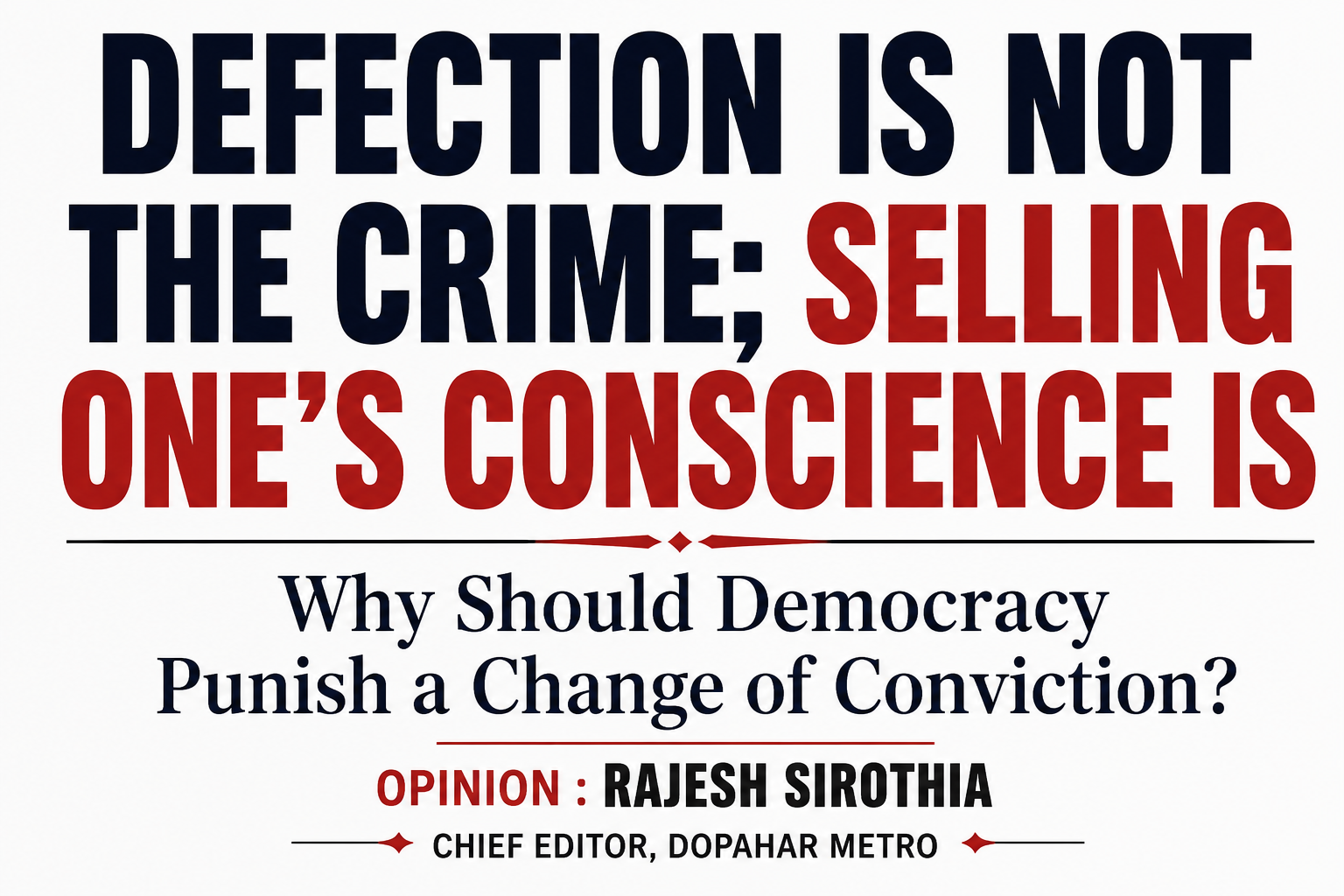
Opinion : Rajesh Sirothia
Chief Editor Dopahar Metro
Indian politics has certain words that instantly invite public condemnation. Defection is one of them. The moment a legislator leaves a political party, they are branded an opportunist, a traitor, or someone who has been bought. No court is required, no evidence is examined. Political parties and the media often deliver the verdict long before the facts are known.
But is every political defection an act of betrayal?
I believe that is the wrong question.
The real question is this: Does a democracy recognize an individual’s right to change their convictions? If the answer is yes, then why should an elected representative be denied that very right?
Democracy is not merely about elections; it is fundamentally about the freedom of conscience. If a Member of Parliament or a legislator is expected to surrender independent judgment entirely to the party leadership, they cease to be representatives of the people and become representatives only of the party. Parliament and state legislatures then risk becoming arenas of numerical strength rather than institutions of deliberation.
Consider the irony.
An ordinary citizen is free to criticize the government, disagree with the Prime Minister, or question a judicial verdict. Yet the same citizen, once elected to Parliament or a state legislature, is expected to place his or her conscience entirely under the discipline of the party whip.
Is this the true spirit of democracy?
India’s anti-defection law was enacted under exceptional political circumstances. Its objective was both legitimate and necessary—to prevent legislators from being bought and sold in the marketplace of power. No democracy can afford political corruption disguised as parliamentary arithmetic.
The problem, however, began when the law failed to distinguish a purchased conscience from an awakened conscience.
This is where I draw a distinction between party defection, conviction, and corruption.
A change of conviction occurs when an elected representative genuinely believes that the political party has departed from its declared principles or that public interest demands a different course. Such a representative is prepared to return to the people and seek a fresh mandate. One may debate the morality of such a decision, but it is difficult to describe it as a crime.
By contrast, a change driven by personal gain is something entirely different. When a legislator changes allegiance for money, ministerial office, political protection, or any other material benefit, the issue is no longer political disagreement—it is corruption. If democracy faces a genuine threat, it comes from this kind of transaction, not from an honest change of belief.
A legitimate objection immediately arises: Who decides whether a legislator acted out of conviction or out of financial inducement? This is undoubtedly a difficult question. Yet the possibility of abuse has never been a sufficient reason to reject a sound principle. Courts routinely distinguish murder from self-defence, corruption from lawful conduct, and fraud from legitimate transactions. Similarly, constitutional democracies must evolve credible standards to distinguish an authentic change of conviction from political bribery.
It is time, therefore, to revisit India’s anti-defection law—not merely from the perspective of political convenience but from the standpoint of democratic philosophy. Legislators who defect for money or office deserve the severest constitutional penalties. But those who change course because of genuine ideological disagreement, and who are willing to seek a fresh mandate from the electorate, should not be treated as constitutional offenders.
The gravest offence in a democracy is not changing political parties.
The gravest offence is selling one’s conscience.
A change of party may alter a government.
But the sale of conscience alters the very character of democracy.
Governments can always be rebuilt.
A democracy that loses its moral character may take generations to recover