News analysis
By Rajesh Sirothia Chief Editor , Dopahar Metro
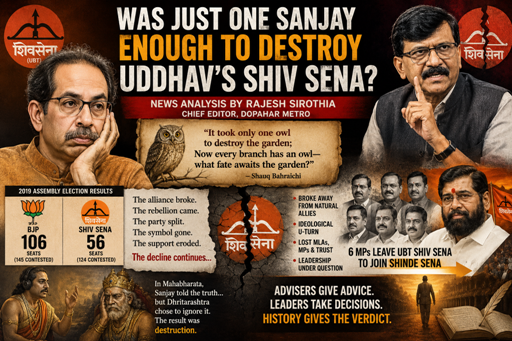
The reported decision of six Members of Parliament from Shiv Sena (UBT) to align themselves with Eknath Shinde’s Shiv Sena has once again revived a crucial question in Maharashtra politics: who bears the greatest responsibility for the steady political decline of Uddhav Thackeray and his party? This episode reminds me of two men named Sanjay—one from the Mahabharata and the other from contemporary Maharashtra politics, Sanjay Raut.
In the Mahabharata, Sanjay served as the eyes of the blind King Dhritarashtra, narrating the events of the Kurukshetra war exactly as they unfolded. The tragedy was not that Sanjay failed to tell the truth; it was that Dhritarashtra, blinded by his attachment to his sons, chose to ignore it. The result was the complete destruction of the Kaurava empire.
The situation also brings to mind the famous couplet by poet Shauq Bahraichi:
“It took only one owl to destroy the garden;
Now every branch has an owl—what fate awaits the garden?”
The metaphor suggests that a flourishing institution can be ruined by the misguided advice or destructive influence of even a single individual. For years, Sanjay Raut’s role in Maharashtra politics has remained a subject of debate. As Shiv Sena (UBT) continues to shrink politically, that debate has become even more relevant.
The roots of the present crisis lie in the 2019 Maharashtra Assembly election. The BJP and Shiv Sena fought the election as pre-poll allies and secured a comfortable majority together. The BJP contested 145 seats and won 106, while Shiv Sena contested 124 seats but managed to win only 56. Not only did the BJP secure far more seats, but its strike rate was also significantly higher.
One important fact is often overlooked in discussions surrounding the post-election dispute. Balasaheb Thackeray himself had accepted a simple principle during the BJP–Shiv Sena alliance years: the party winning more seats would have the right to claim the Chief Minister’s post. Following that understanding, Shiv Sena leader Manohar Joshi became Chief Minister in 1995 when Shiv Sena was the larger partner. In 2014, after the BJP emerged as the dominant party by winning 122 seats against Shiv Sena’s 61, Devendra Fadnavis became Chief Minister. By the same logic, the BJP’s claim to the Chief Minister’s office in 2019 appeared politically justified.
However, advisers such as Sanjay Raut steered the Thackeray family in a different direction.
A large section of political observers believes that it was during this period that Sanjay Raut played the most influential role in persuading Uddhav Thackeray to break away from the BJP. Political circles have long viewed Raut as being exceptionally close to Sharad Pawar, while his relationship with the BJP leadership was never particularly cordial. Acting on this political advice, Shiv Sena chose to form a government with the Nationalist Congress Party (NCP) and the Congress—an alliance that stood in sharp ideological contrast to Balasaheb Thackeray’s lifelong political convictions. Balasaheb had often declared that he would rather die than join hands with the Congress.
From that point onward, events unfolded rapidly. More than forty Shiv Sena MLAs led by Eknath Shinde revolted, bringing down the Uddhav government. Eventually, the Election Commission recognised the Shinde faction as the official Shiv Sena and awarded it the party’s traditional election symbol. The party’s disappointing performance in the 2024 Assembly elections further weakened Uddhav Thackeray’s position. The departure of six Members of Parliament now indicates that the crisis extends beyond organisational weakness—it reflects deeper problems of leadership and political strategy.
Today, Sanjay Raut continues to launch fierce attacks on political opponents and harshly criticise those leaving the party while invoking the language of political morality. Yet when a party continues to lose its legislators, leaders and public support, blaming defectors alone cannot substitute for honest introspection. Self-correction is the first requirement for the revival of any political organisation.
Political advisers undoubtedly matter, but the final responsibility always rests with the leader. When leaders distance themselves from their natural political allies and become overly dependent on a small circle of advisers, the consequences can be far-reaching. This is not a phenomenon confined to Maharashtra; similar questions have also been raised from time to time about the influence of advisory circles around Rahul Gandhi in national politics.
Indian politics is now entering a new phase. With the implementation of the Women’s Reservation legislation and the possibility of future delimitation, political equations are likely to undergo significant changes. In such an environment, politics driven merely by opposition for its own sake is unlikely to resonate with voters. The electorate increasingly expects stability, clarity of leadership and effective governance.
History ultimately judges not only leaders but also the decisions they make and the advisers they choose to trust. If an objective history of Uddhav Thackeray’s political journey is ever written, Sanjay Raut’s role will undoubtedly receive close scrutiny. It may not conclude that one adviser alone was responsible for Shiv Sena’s decline, but it will certainly ask whether the greater mistake lay with the adviser—or with the leader who accepted every piece of advice as unquestionable truth.