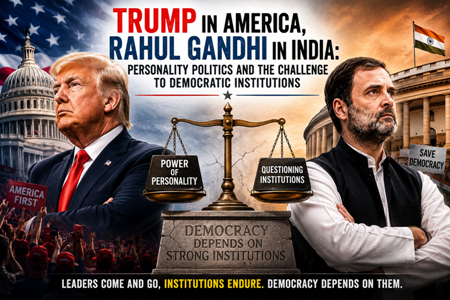
Trump in America, Rahul Gandhi in India: Personality Politics and the Challenge to Democratic Institutions
Perspective: Rajesh Sirothia
At first glance, U.S. President Donald Trump and India’s Leader of the Opposition, Rahul Gandhi, appear to represent two entirely different political worlds. Trump is the face of right-wing nationalist politics in the United States, while Rahul Gandhi is the principal leader of the Indian National Congress, the party that spearheaded India’s freedom movement. Yet, over the past several months, I have found myself reflecting on an intriguing question: despite their ideological differences, do these two leaders share certain political traits? After considerable thought, I believe they do—not in ideology, but in political style.
To understand Rahul Gandhi’s politics, one must first understand the ideological evolution of the Congress Party. Many political observers regard Maharshi Purushottam Das Tandon as the last influential Congress president to represent the party’s nationalist-conservative tradition. After his resignation, Jawaharlal Nehru assumed the presidency of the Congress while simultaneously serving as Prime Minister, consolidating control over both the government and the party. From that point onward, Congress gradually moved toward a socialist and Left-leaning ideological orientation.
The 1962 defeat in the Sino-Indian War raised serious questions about the strategic assumptions of that era. Later, following the 1969 split in the Congress, Indira Gandhi strengthened her political position with the support of communist parties. In the decades that followed, Left-oriented scholars and intellectuals came to wield significant influence in several academic, historical, and cultural institutions. The Bharatiya Janata Party (BJP) and its ideological affiliates have long argued that this created an intellectual imbalance and have sought to reshape those institutions, while their critics view these efforts as politically motivated. This debate continues to shape India’s ideological landscape.
Rahul Gandhi is, in my assessment, the latest political representative of that long ideological evolution. Although Mallikarjun Kharge formally heads the Congress Party, its political direction continues to revolve around the Gandhi family. While Priyanka Gandhi has emerged as an increasingly active leader, Rahul Gandhi remains the central political figure.
My concern is less about Rahul Gandhi as an individual than about his style of politics. In any democracy, the opposition has both the right and the responsibility to question the government. However, when criticism consistently extends to Parliament, constitutional institutions, electoral processes, and other democratic pillars, it risks eroding public confidence in the institutions that sustain democracy itself. A responsible opposition should not only oppose the government but also present a credible alternative vision.
Donald Trump’s political journey in the United States presents a different, yet in some respects comparable, story. Trump reinvigorated American nationalism and reshaped the Republican Party, but his unconventional leadership style also generated intense domestic and international debate. Institutions such as the American First Policy Institute played an important role in developing a nationalist policy agenda ahead of his return to power.
In my view, one of Trump’s greatest political challenges has been the perception that his foreign policy decisions and his family’s business interests were not always seen as clearly separate. His changing approach toward Pakistan, shifting priorities in the Middle East, and evolving posture on Iran have raised questions among both allies and critics. History will ultimately judge those decisions, but the debate has already begun.
This is where I find an interesting parallel between Trump and Rahul Gandhi. Both are admired passionately by their supporters and criticized intensely by their opponents. Both have become larger-than-life political personalities. Their politics increasingly revolves around personal leadership rather than institutional strength. The difference, however, is that Trump sought to reshape institutions while exercising executive power, whereas Rahul Gandhi often challenges institutional credibility from the opposition benches.
Neither India nor the United States is defined by a single political leader. Democracies endure because of the strength of their institutions, not the popularity of individuals. History repeatedly reminds us that when personality begins to overshadow institutions, democratic resilience is tested.
This article is not intended as an endorsement or condemnation of either Donald Trump or Rahul Gandhi. Rather, it is a reflection on a larger democratic concern. Political leaders come and go, governments rise and fall, but institutions are the enduring foundations of a nation. Leaders who strengthen those institutions leave behind a lasting legacy. Those who weaken public faith in them, intentionally or otherwise, are ultimately judged far more harshly by history.
- Advertisement -